Medical Billing Services for US Practices at a Flat 2.99% of Collections

Medical billing services are the work that starts when your patient walks out the door: checking coverage, coding the visit, sending the claim, posting the payment, chasing denials, and billing the patient for what is left. Orbix RCM does all of it for a flat 2.99% of what we collect. No setup fee. No minimum. If we collect nothing, you pay nothing.

2.99%Flat fee on collections
$0Setup fee, no minimum
$0Owed if we collect nothing

Who Our Medical Billing Services Are For

We work with US practices that have one of three problems:

Claims sit unpaid.

Nobody has time to follow up past 30 days.

Denials pile up.

They get written off instead of appealed.

Billing depends on one person.

When they are out, cash slows down.

What Our Medical Billing Services Cover for One Percentage

The 2.99% covers eight jobs. You do not get a separate bill for any of them.

Medical Billing Services Inside Your EHR, Without Changing Your Workflow

We work inside your EHR through a secure user account your practice creates. Your doctors keep the system they know.

  • Your EHR stays
  • Your clearinghouse stays
  • You control access

One secure user account

Created by your practice, so you decide who has access.

From Checkout Desk to Bank Deposit: The Path of One Claim

1

Check coverage

We confirm the patient’s plan is active

270/271
2

Code and send

We code the visit and send the claim

837P, CMS-1500
3

Confirm receipt

The clearinghouse and payer accept or reject it

999, 277CA
4

Get paid

The payer pays or denies, and sends an explanation

835 ERA/EOB
5

Follow up

We post the payment and work what is short or denied

CARC, RARC codes

Most problems start at step 2. A wrong code or a missing authorization is cheap to fix before the claim goes out and expensive to fix after a denial.

The Denials We Caught: A Missing Authorization and a Plan Denial

The quickest way to see what medical billing services do is to see a claim go wrong. These two cases are from our own work.

A denied claim corrected and appealed until it is paid

Case 1: The missing authorization

An occupational therapy practice was dropped from an Evolent network because authorizations were missing on its claims.

Case 2: The Medicare managed care denial

A Medicare managed care plan denied a claim.

Both cases show the same thing: a denial or a missing authorization is cheap to deal with early and expensive once it sits.

What an Unworked Denial Costs

Here is an example with round numbers. It is an illustration, not a client result.

Multiply that by every denial a busy front office does not have time to chase.

Claim billed$120
Payer allowed$96
Payer paid, after a denial that was never worked$0
Left on the table$96

Who Sends the Statement? Patient Billing and Collections

Patient balances are the slow part of billing. Insurance pays on a schedule. Patients pay when they understand the bill, so the statement matters.

Orbix handles

Electronic patient statements

Your front office handles

Paper patient statements

Follow-up calls to patients about balances

What a Good Patient Statement Shows

Every statement should carry these five things
  • Your practice name and phone number
  • The date of service and what was provided
  • What was charged, what insurance paid and any adjustments
  • What the patient owes
  • How to pay and when payment is due

A statement goes out only after the payer has finished with the claim. Bill a patient while the claim is pending and you will take an angry call about a balance that may shrink.

Collections: Settle These in Writing

Before you sign with any billing company, settle these:

  1. Who sends the first statement?
  2. How many reminders go out, and how far apart?
  3. Who offers payment plans?
  4. When does an unpaid balance go to an outside collection agency, if ever?
  5. Who is allowed to adjust or write off a balance?

What Medical Billing Services Cost When You Only Pay on Collections

Our fee is a flat 2.99% of collections. You pay it on money we bring in. It covers everything listed above, except one cost: the $20 EFT application fee.

You collect in a month$50,000Our fee at 2.99%: $1,495
You collect in a month$100,000Our fee at 2.99%: $2,990
You collect in a month$250,000Our fee at 2.99%: $7,475

How Other Billing Models Compare

Other billing companies charge a percentage, a flat monthly fee or a fee per claim, so look at what the fee is based on, not only the rate.

Percentage of collections

Fee is a share of payments received

Watch forCharges or collections? Do patient payments count?

Flat monthly fee

Fixed fee every month

Watch forYou pay the same in a slow month

Per-claim fee

A set price for each claim

Watch forCost rises with volume and may not include denial work

Orbix

Flat 2.99% of collections

Watch forEverything in the list above

Leaving Our Medical Billing Services: One Month’s Notice, Your Data Back

The minimum term is one year, with one month’s notice. Leave without giving notice and you pay one month’s invoice, based on your last month of billing. Your data stays yours. We hand it back and help move your enrollments. The full breakdown is on our pricing page.

Get a Free RCM Audit

Live in 2 to 3 Weeks: What Happens Before Your First Claim Goes Out

Most practices are live in 2 to 3 weeks.

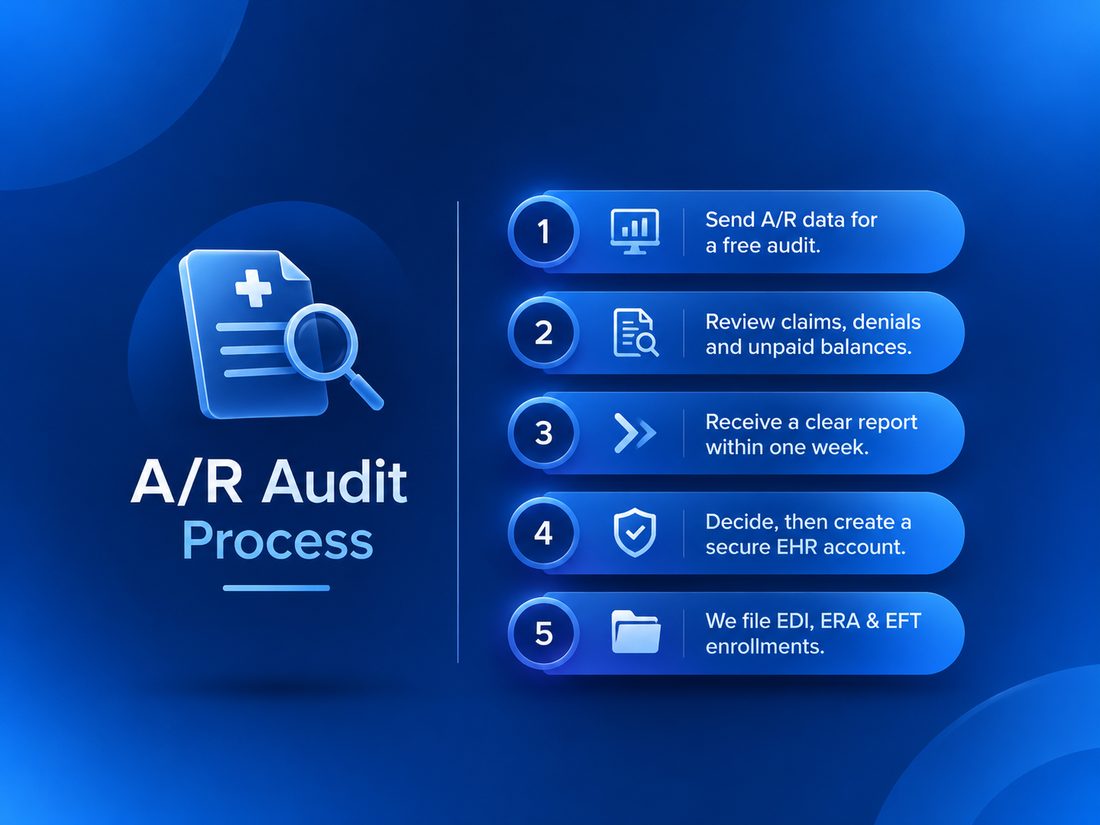
  1. You send us your A/R data for the free audit.
  2. We review claims, denials and unpaid balances and send a clear report within one week.
  3. You decide whether to go ahead.
  4. Your practice creates a secure user account in your EHR for us.
  5. We file your EDI, ERA and EFT enrollments whenever your doctor is ready.
A/R audit report showing unpaid claims by age

The Free A/R Audit: What You Get Back

Send your A/R data. We review your claims, denials and unpaid balances. Within one week you get a clear report. It is free, and you are not committed to anything by asking for it.

The only cost in this process is the $20 EFT application fee.

Medical Billing Services vs a Biller Down the Hall

In-house billing gives you a person down the hall. It also gives you salary, benefits, software, sick days and one person who is the only one who knows how it works. Outsourcing swaps those fixed costs for a percentage of what is collected. Some practices keep a front-office person for patient questions and outsource the rest. That hybrid is common.

To compare fairly, add up what billing costs you now, including the denials nobody has time to work. Then compare that total with a percentage of collections.

One in-house biller compared with a team that follows every claim

Five Questions to Put in Writing Before You Hire Any Billing Company

There are many medical billing companies in the USA, and most sound alike on the first call. Ask each one the same five questions:

  1. What is the fee based on: charges or collections?
  2. What does the fee cover, and what costs extra?
  3. Do you work inside my EHR?
  4. How can I leave, and what do I get back when I do?
  5. What will you report to me every month?

Four Numbers Your Monthly Report Should Always Show

Clean claim rateHow many claims are accepted on the first try
Denial rateHow many claims the payer turns down
Days in A/RHow long it takes to get paid
Net collection rateHow much of what you were owed you actually collect

When Our Medical Billing Services Are Not the Right Fit

We are not the right choice for everyone.

If you are unsure, the free audit shows what we would find before you commit to anything.

Medical Billing Services for Physician Practices by Specialty

The basics are the same everywhere. The trouble spots are not.

HIPAA and Your Patient Data

We work through a secure user account your practice creates, so you decide who has access. We follow HIPAA-compliant processes. If you leave, your data is returned to you.

Questions We Asked Waseem Ali About Running Medical Billing Services Day to Day

1. What is the first thing you check when a practice sends you its A/R data?

The aging report. I look at how much money is stuck over 90 days. Under 20% is healthy. Over 30% means something is broken. Then I check:

  • Days in A/R (target: 30 to 40)
  • Clean-claim rate (95% or higher)
  • Denial rate (under 5%)
  • Top denial reasons
  • How fast charges go out
  • Which payer owes the most

2. What denial do you see most often?

Eligibility and authorization. Either the coverage ended (CO-27) or there was no prior auth (CO-197). After that come medical necessity, missing information, duplicates, bundling and timely filing. Most are preventable. We verify coverage 2 to 3 days before the visit, check auth rules, and fix the root cause instead of just resending the claim.

3. What does a practice usually get wrong before they come to you?

  • Charges go in late (they should go out within 1 to 2 days).
  • Denials aren’t tracked, so the same mistakes repeat.
  • Filing deadlines get missed, and that money is gone.
  • Insurance isn’t verified properly at the front desk.

4. What happens in the first week after a practice signs?

  • Days 1 to 2: We get system access and set up payers and claim submission.
  • Days 3 to 4: We audit old A/R and denials, urgent claims first.
  • Day 5: We map their workflow and agree on reports.

5. When do you tell a practice to stay with its in-house biller?

When their biller already hits the targets: A/R over 90 days under 20%, clean claims above 95%, and denials under 5%. Also when volume is too low to justify the fee, or when the real problem is front-desk or provider documentation, which a billing company can’t fix.

Medical Billing Services FAQ

What does a medical billing service do?

It turns patient visits into paid claims. That means checking coverage, coding the visit, submitting the claim, posting the payment, appealing denials, following up on unpaid claims and sending patient statements.

What is the average cost of medical billing services?

Billing companies usually charge a percentage of collections, a flat monthly fee or a fee per claim. Orbix charges a flat 2.99% of collections, with no setup fee and no minimum.

How do I choose among medical billing companies?

Compare them on the same points: what the fee is based on, what it covers, whether they work in your EHR, the exit terms and what they report each month. Ask for all five in writing.

Is outsourcing cheaper than in-house billing?

It depends on your situation. Add up salaries, benefits, software and the cost of unworked denials, then compare that total with a percentage of collections.

Do you work with my EHR?

Yes. We work inside your EHR through a secure user account your practice creates, so your doctors do not have to change anything.

Is there a contract or lock-in?

The minimum term is one year, with one month’s notice. If you leave without notice, you pay one month’s invoice based on your last month of billing. Your data stays yours.

How are patient data and HIPAA handled?

We use a secure account created by your practice and follow HIPAA-compliant processes. Your data is returned to you if you leave.

How fast can we start?

Most practices are live in 2 to 3 weeks. We file the payer enrollments whenever your doctor is ready.


Ready to See What You Are Leaving Behind?

Send us your A/R data. We review your claims, denials and unpaid balances and send you a clear report within one week. It is free.